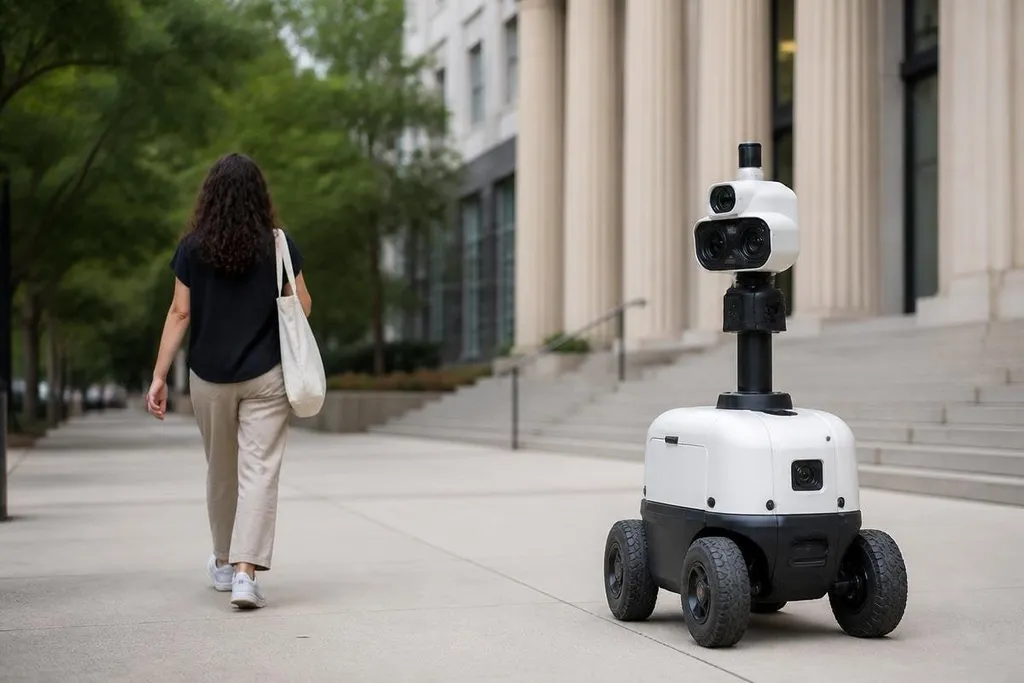
A robot with cameras, microphones, or facial recognition can watch people without speaking to them. The hard question is not whether the robot can collect data, but who may use that data, for what reason, and under whose control.
- A camera robot can turn a public space into a place of constant recording.
- Autonomous movement can make surveillance harder to notice or avoid.
- Human rights rules still apply when software makes part of the decision.
What surveillance robots can do
Surveillance robots range from remote-controlled ground vehicles to autonomous systems that move through a site with limited human input. They may record video, detect motion, read license plates, map an area, or send alerts to a control room.
That mix changes the scale and timing of observation. A fixed camera watches one view. A mobile robot can move toward a person, follow a route, return to a charging point, and collect data from several places during one shift.
The robot may also combine video with other data. A system that links a face, location, time, and movement pattern can create a record about a person even when no one speaks to them. That record can affect access to a building, a workplace investigation, or a police inquiry.
Human review does not remove the risk. A staff member may trust an alert because it came from a machine, even when the camera was blocked, the lighting was poor, or the software read a face incorrectly.
The rights at stake
Privacy is the clearest concern, but it is not the only one. People also need protection from unfair treatment, unjustified searches, and decisions they cannot challenge.
At a protest, the system may record people who have done nothing wrong. That can affect freedom of assembly if people avoid a lawful event because they expect their faces, voices, or movements to enter a database.
Accuracy matters too. Facial recognition and behavior detection can produce false matches. A false alert may lead to questioning, removal from a site, or a record that remains in a system after the original error is forgotten.
The setting changes the balance. A robot checking a restricted industrial area has a different purpose from one watching a school entrance, a housing block, or a public demonstration. The same sensor can be reasonable in one place and intrusive in another.
That difference also changes what gets recorded. Surveillance robot data practices should be tied to the sensor, location, operator, and retention rule. Those details lead to the next issue: who controls the data?
Who controls the data?
A rights-based review starts before a robot enters service. The operator should state what the system records, how long it keeps the data, who can view it, and when it must delete the files.
People also need a clear way to ask why they were recorded or flagged. A process that offers no notice, no human review, and no appeal leaves too much power with the operator and the software vendor.
Security is part of the same problem. A hacked robot can expose live video, stored footage, building maps, and audio. Remote access should have named owners, access logs, strong account controls, and a plan for shutting the system down when something goes wrong.
The vendor's contract matters. It should state who owns the data, whether the vendor can reuse it, where copies are stored, and what happens when the contract ends. A buyer cannot protect people if the data path remains unclear.
A practical review before deployment
Use this checklist before buying or approving a surveillance robot:
- Purpose: Write the exact safety or security task. Reject broad wording such as “general monitoring.”
- Location: Check whether people can avoid the robot without losing access to work, housing, education, or public services.
- Data: List every sensor, data type, retention period, and person with access.
- Human control: Set the alerts a person must review before any action affects someone.
- Accuracy: Test the system in the real light, weather, clothing, and crowd conditions it will face.
- Redress: Give people a named contact, a review process, and a way to correct false records.
This process should include workers, local residents, civil rights groups, and technical staff. Their questions can expose a problem that a purchase review misses, such as a microphone recording nearby homes or a route passing through a place where people expect privacy.
What remains unproven
A robot can carry out a task without proving that the task is lawful or fair.
Labels such as “autonomous” describe how the system moves or reacts; they do not decide whether its use respects human rights.
I'd approve a surveillance robot only for a narrow, stated purpose with short data retention and a real appeal process. Without those limits, the machine turns routine observation into a lasting record, and the operator may not notice the harm until someone has to fight to remove it.
The next decision is not whether the robot can watch. It is whether the operator can explain every recording, every alert, and every person who gains access.